




Your Kundli or birth chart is a sort of cosmic blueprint of your life in Vedic astrology. It shows insight into personality, career, relationships, and destiny all based on the positions of planets at the exact time of birth. Whether you explore astrology out of curiosity or to get guidance on marriage, understanding how to read Kundli will help you tap into the deeper layers of your life journey.
What is Kundli? - Understanding Kundali Meaning
Before going into the details of how to read the Kundli, let us understand its essence. The Kundali meaning is that it is a birth chart or horoscope, which is prepared using the date, time, and place of an individual's birth. It represents the positions of all nine planets, namely Sun, Moon, Mars, Mercury, Jupiter, Venus, Saturn, Rahu, and Ketu, at the time you were born.
The chart in Vedic astrology consists of 12 houses, each representing different aspects of life, such as health, wealth, love, marriage, and career. Reading a Kundli means looking at which planets sit in which houses and signs.
Kundli Reading Step by Step
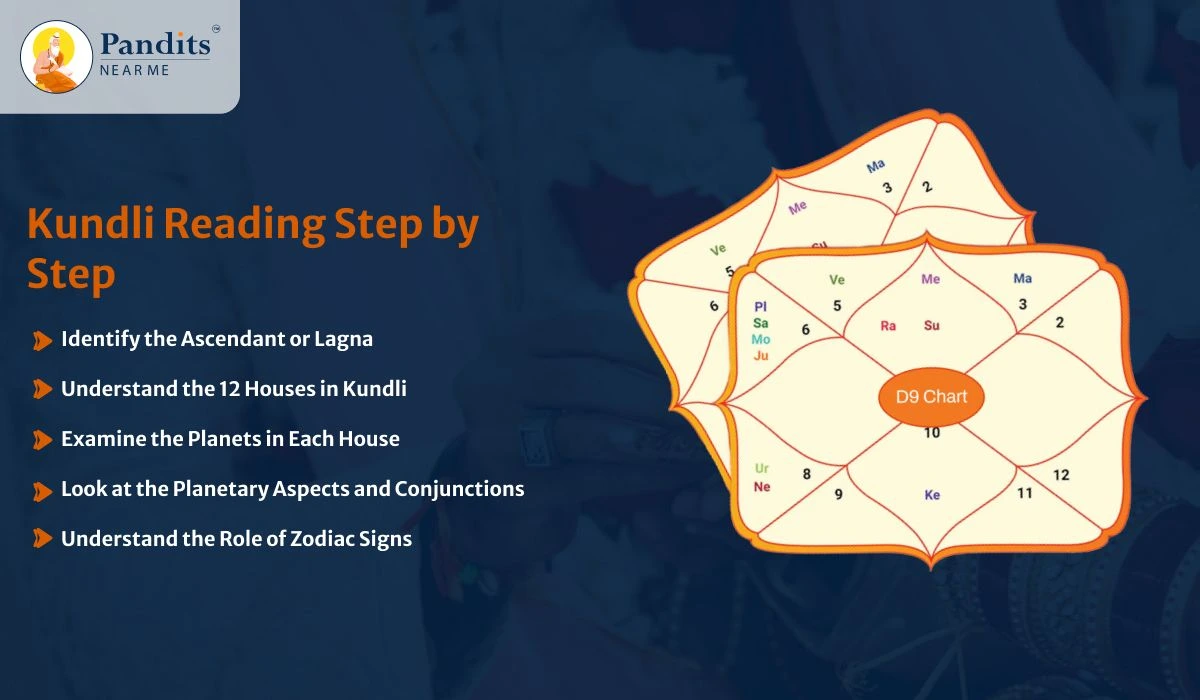
The basic understanding of how to read Kundli involves learning its structure. By convention, a Kundli is a square or diamond-shaped diagram that is divided into 12 sections; these are the houses or Bhavas. Each house and each planet will be telling something different about various aspects of your life.
Here's a breakdown of the key steps for getting started:
1. Identify the Ascendant or Lagna
The Ascendant or Lagna is the sign rising on the eastern horizon at the time of birth. This forms the base of the horoscope and decides the placing of other planets in the chart.
In the chart, the Lagna is always the first house. It represents you — your body, personality, appearance, and approach to life.
For instance, if Aries (Mesh) falls in the first house, the natives will be energetic, bold, and action-oriented. In case it is Cancer-Karka, you may be emotional, nurturing, and intuitive.
2. Understand the 12 Houses in Kundli
Every chart has 12 houses (Bhavas). Every house or Bhava stands for something different in one's life:
House Number | Represents | Significance |
1st House | Self / Personality | Nature, health, confidence |
2nd House | Wealth / Speech | Finances, family, communication |
3rd House | Courage / Siblings | Strength, efforts, short travels |
4th House | Home / Mother | Comfort, property, emotional stability |
5th House | Creativity / Children | Love, education, intelligence |
6th House | Enemies / Health | Debts, diseases, daily work |
7th House | Marriage / Partnership | Spouse, relationships, business |
8th House | Transformation | Sudden change, secrets, inheritance |
9th House | Luck / Religion | Higher learning, spirituality, fortune |
10th House | Career / Profession | Status, work, public image |
11th House | Gains / Desires | Success, income, social circle |
12th House | Loss / Liberation | Expenditure, foreign travels, spirituality |
3. Examine the Planets in Each House
Each of the planets carries its own energy and meaning; the placement in specific houses affects the outcomes related to that house. For example:
• Sun in the 10th house is traditionally linked with leadership and a focus on career.
• The moon in the 4th house gives a person emotional depth and attachment to home.
• Venus in the 7th house brings charm, romance, and success in relationships.
• Saturn in the 6th house: discipline, endurance, and success after hard work.
While reading the lagna chart, always combine the nature of the planet with the house it occupies and the zodiac sign it is in.
4. Look at the Planetary Aspects and Conjunctions
Planets in a Vedic astrology chart have an influence, called drishti, on other houses and planets. These aspects and conjunctions tell you how the different energies interact.
For instance,
• Jupiter can give a wise and supportive partner when it aspects the 7th house.
• Mars aspecting the 10th house exhibits ambitions and courage in career.
• Saturn's aspect slows it down but gives long-lasting stability.
5. Understand the Role of Zodiac Signs
The 12 zodiac signs are also called Rashis, and each planet is the ruler of a certain sign. The sign in each house is believed to colour how that area of life is expressed.
For example,
Aries: bold, fast, impulsive energy
• Taurus-Vrishabha: practical, stable, and materialistic
• Gemini (Mithuna): curious, talkative, intellectual
• Cancer (Karka): emotional, caring, intuitive.
• Leo (Simha): Confident, creative, leadership-oriented
• Virgo: Kanya; analytical, precise
• Libra-Tula: Balanced, charming, and relationship-oriented.
• Scorpio-Vrishchik: Intense, secretive, passionate
• Sagittarius or Dhanu: spiritual, optimistic, adventurous
• Capricorn-Makar: ambitious, disciplined, and practical.
• Aquarius-Kumbha: innovative, social, humanitarian
• Pisces (Meen): Dreamy, spiritual, compassionate
The combination of sign + planet + house shows your personality, challenges, and destiny.
Also read this article: Manglik Dosha in Girls
How to Read Kundli for Marriage
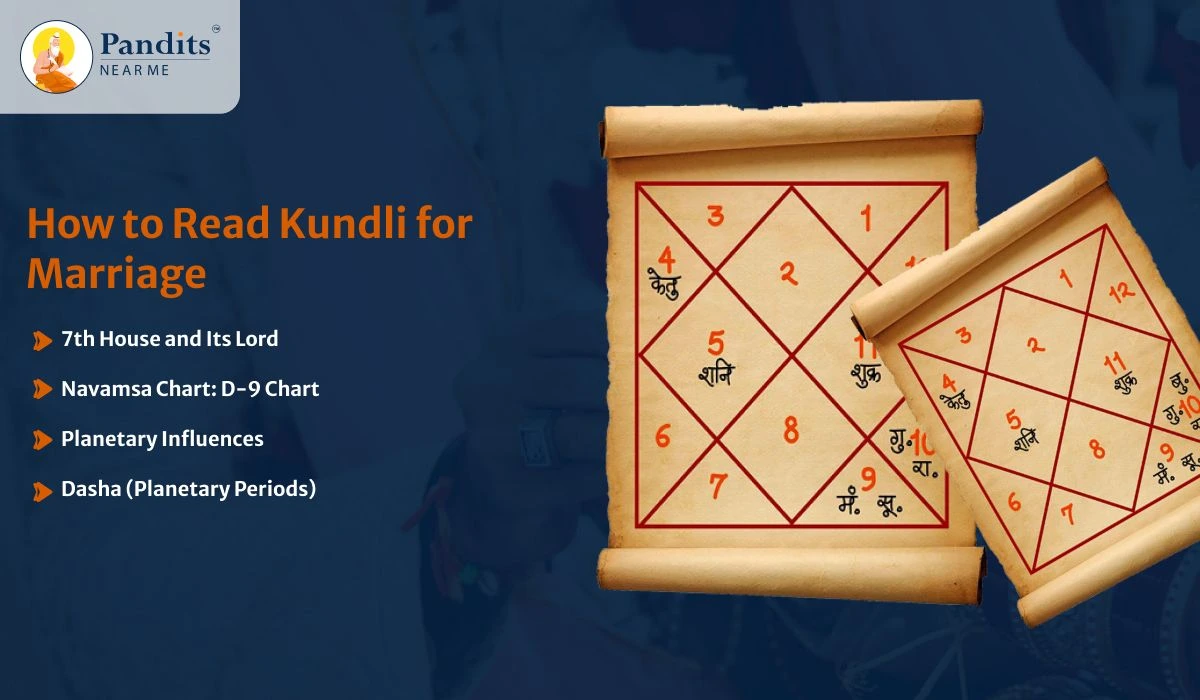
One of the most common uses of astrology involves learning how to read Kundli for marriage. The 7th house stands for marriage, spouse, and partnerships according to Vedic astrology.
Following is what one should look for while analyzing a Kundli for marriage compatibility:
1. 7th House and Its Lord:
The condition of the 7th house and its ruling planet shows the quality of your marriage and the nature of your spouse.
A well-placed Venus or Jupiter is traditionally seen as supportive for marriage.
Astrologers also check the influence of planets such as Mars or Saturn, which some traditions link with delays.
2.Navamsa Chart: D-9 Chart
The Navamsa or D-9 chart is indispensable in marriage analysis. It gives deep insight into your marital happiness and compatibility.
3. Planetary Influences:
Traditionally, Venus is studied for a man's chart and Jupiter for a woman's chart when looking at marriage.
4. Dasha (Planetary Periods):
Astrologers also look at the Dasha (planetary period) running around the time of marriage.
Astrologers read these factors together; no single placement decides a marriage.
For a detailed look at marriage yogas, see our guide to Vivah Yog.
How To Read Lagna Chart – The Core of Kundli Analysis
The Lagna chart reading is the basis for your entire horoscope. It is the main Vedic astrology chart, which shows how your planets shape your physical, emotional, and spiritual journey.
Key Aspects to Focus On:
• Lagna or Ascendant Sign: It defines your body and personality.
• Moon Sign or Rashi: denotes your feelings and inner self.
• Sun Sign or Surya Rashi is the sign of one's soul's purpose and confidence.
• Planetary Strength: Firstly, check for exalted or debilitated planets, strong or weak.
Yogas: special planet combinations, such as Gaja Kesari Yoga, Raj Yoga or Dhana Yoga, which are traditionally linked with success or wealth.
During lagna chart reading, astrologers also analyze divisional charts like Navamsa, Dasamsa, etc., to delve deep into marriage, career, and spirituality.
How Planetary Positions Affect Your Life
Your Vedic astrology chart is a snapshot of cosmic energy at your birth. Each of the planets, according to its position, governs various areas of your life:
Planet | Represents | Effect in Kundli |
Sun | Soul, leadership, authority | Confidence, recognition, vitality |
Moon | Mind, emotions | Peace of mind, mood stability |
Mars | Energy, courage | Passion, drive, aggression |
Mercury | Intelligence, communication | Logic, learning, speech |
Jupiter | Wisdom, growth | Knowledge, wealth, blessings |
Venus | Love, beauty, luxury | Relationships, comforts, creativity |
Saturn | Discipline, karma | Patience, responsibility, struggles |
Rahu | Desires, illusion | Material ambition, obsession, unconventional results |
Ketu | Detachment, spirituality | Intuition, past-life influence, liberation |
Each planet also rules certain houses, so the same planet can affect more than one area of life.
Common mistakes to avoid while reading Kundli
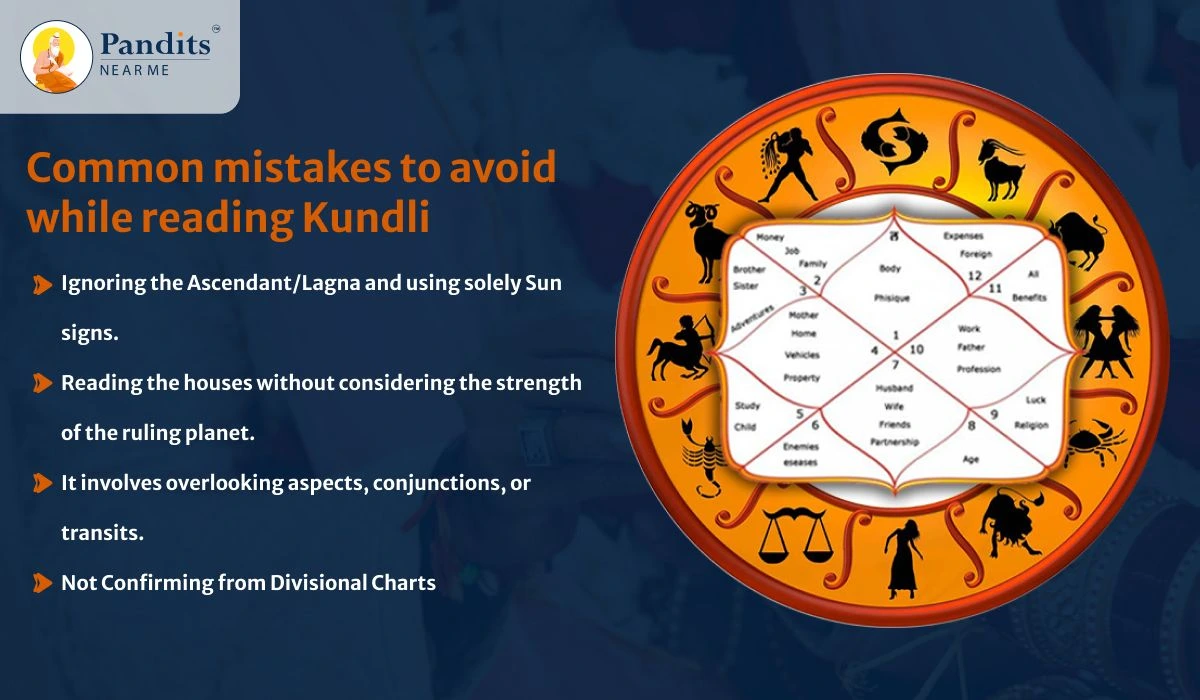
Even while you know how to read Kundli, there are a few common mistakes made by a beginner. Here are some to avoid:
• Ignoring the Ascendant/Lagna and using solely Sun signs.
• Reading the houses without considering the strength of the ruling planet.
• Overlooking aspects, conjunctions or transits
• Not checking divisional charts such as the Navamsa (D-9).
A Vedic astrology chart is always to be interpreted as a whole picture; every detail plays an important role.
Importance of Kundli Reading in Modern Life
Even in this digital era, Kundli reading is considered one of the trusted ways of understanding personality, compatibility, and destiny. This helps with:
• Professional/career and business decisions
• Relationship and marriage guidance
• Spiritual growth and self-awareness
Kundli reading is a traditional guide, not a replacement for medical, financial or legal advice. For health or money decisions, please consult the right professional. Knowing how to decipher Kundli houses and planetary positions helps to empower one in making conscious choices in tune with one's true direction.
Conclusion
The art of learning how to read Kundli houses is not to predict the future; it is to understand oneself and the patterns running in life. The moment one learns how to read Lagna chart, identify houses in Kundli, and interpret the Vedic astrology chart, one starts to see the patterns astrologers look for.
Kundali is your guideline, not your limitation. Yes, the planets have an impact on you, but it is through your actions and awareness that you define your journey.
Take the time to delve deep into your chart, understand its message, and realign with the cosmic rhythm that is inscribed among the stars.
If you would like your own chart explained, an astrologer from Pandits Near Me can go through your Lagna, houses and planetary periods with you and answer your questions.